
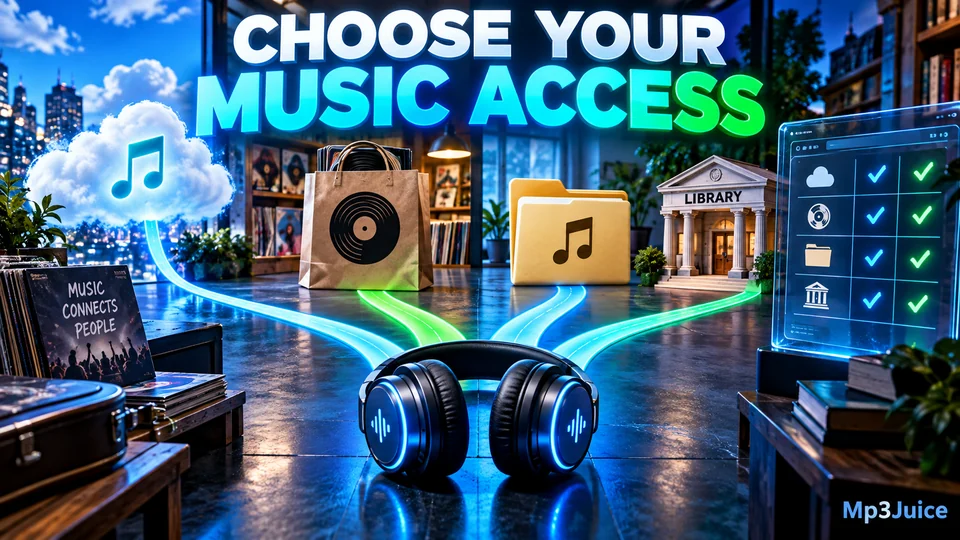
The legal alternatives to MP3Juice fall into four routes: streaming apps with an offline mode, stores that sell files, free downloads offered by artists, and public-domain or open-licence libraries. In each of them the music comes from the artist, the label or the licence itself, so the right to listen is not in doubt. They differ in what you end up holding: a file that is yours to keep, or music that plays only inside an app.
This article compares the four routes by where the music lives, what it costs and what you may do with it. Tools that work the way this site does, by search and conversion in the browser, are a different subject. They are compared on the page of MP3Juice alternatives.
How legal alternatives to MP3Juice differ from a search tool
A search tool and a licensed service start from opposite ends. MP3Juice is a search page used in a browser, with no app and no account. It lists matching YouTube videos and passes an MP3 or MP4 request to an external conversion service. It hosts no files of its own. Two things follow. The sound can be no better than the video's audio, and the right to save a recording depends on that recording, not on the tool. Save only material you made yourself, have a licence or permission for, or that is in the public domain or under an open licence. Rules differ by country, and the page on whether MP3Juice is legal shows how to apply the rule.
The routes below differ on those same two points: where the music comes from, and who has said you may have it.
Streaming apps with offline listening
Spotify, Apple Music, YouTube Music and Deezer all let paying subscribers download songs for offline listening inside the app. The catalogues are large and nothing needs organising. Offline music is a paid feature: the free version of Spotify, for example, downloads podcasts only.
What you save is not a file in the usual sense. The download stays inside the app and plays only there. The app also has to go online from time to time. Spotify and YouTube Music each ask for a connection at least once every 30 days to keep downloads available. The saved songs stop playing when the subscription ends. Streaming suits you if you want range and convenience and do not mind renting. For more on listening without a connection, see how to download music offline.
Stores that sell you the file
A download store sells the file itself. Bandcamp is an online record store for artists and labels, and a purchase can be downloaded in several formats, MP3 and FLAC among them. Other stores sell tracks and albums in the same way, so check the format on offer before you pay.
A bought file is an ordinary file. It plays in any player that supports the format, copies to any device you own and keeps working if the store closes. A FLAC download is lossless, so it is not held to the roughly 128 to 160 kbps of a YouTube stream. If you have to pick a format at the checkout, MP3 vs FLAC explains what each gives you. The drawback is cost, since a large collection adds up.
Free downloads that artists offer themselves
Many musicians give tracks away on purpose. On Bandcamp the artist sets the price: a fixed price, a minimum that fans may exceed, or a free download in exchange for an email address. Others post free songs on their own sites or send them to a mailing list.
These are real files offered by the people who made them, which makes this the nearest thing to a free download with clear permission. You will find new and independent music far more often than chart hits, and you have to visit each artist's page. Read the note beside the download. Free to download does not always mean free to re-upload or to use in your own video.
Public-domain and open-licence libraries
Some music is free for anyone to copy because its copyright has expired or because its creator released it under an open licence. The Internet Archive holds an audio collection with many files free to download, among them the Live Music Archive of concert recordings by artists who allow non-commercial sharing. Musopen offers recordings and sheet music without copyright restrictions. Free Music Archive offers open-licensed music by independent artists and shows the Creative Commons licence on each track page. The same libraries are set beside openly licensed YouTube videos on the page about free MP3 download.
Check each item, not the site as a whole. Creative Commons licences vary. Most require you to credit the artist, some forbid commercial use and some forbid remixing. Age is not a simple guide either. A symphony written two hundred years ago is out of copyright, but a recording of it made last year has rights of its own. Expect thin coverage of current hits and uneven sound on older transfers.
The four routes side by side
The table compares the four routes on four points: where the music lives, whether it plays without the app, what it costs and what you may do with it.
| Route | Where the music lives | Plays without the app | Cost | What you may do |
|---|---|---|---|---|
| Streaming with offline mode | Inside the app | No | Monthly subscription | Listen while you subscribe |
| Download store | Ordinary files you keep | Yes | Per track or album | Personal use on your devices |
| Free artist downloads | Ordinary files you keep | Yes | Free or pay what you like | What the artist states |
| Open libraries | Ordinary files you keep | Yes | Free | What each item's licence states |
Which one fits depends on what you want most. Four cases cover most readers:
- For the widest catalogue with no file handling, choose streaming.
- For files that stay yours and come from the artist or the label, use a store.
- For new music at no cost with the artist's consent, look for artist downloads.
- For music you are allowed to reuse in your own project, use an open library and read the licence first.
Once you have files from any of these routes, the guide to downloaded music on every device covers moving and playing them on phones and computers.
Similar tools, compared one by one
Tools that work the way this site does are left out here, because they are a different kind of alternative. Four comparisons each set MP3Juice beside one of them:
- Song search or link converter: MP3Juice vs YTMP3.
- Audio first or video first: MP3Juice vs Y2Mate.
- Music search on a phone: MP3Juice vs Tubidy.
- YouTube music or TikTok clips: MP3Juice vs SnapTik.
Common questions
Can I copy songs saved in a streaming app to a USB stick?
No. Offline tracks stay locked inside the app that saved them. Spotify on Android can keep its downloads on an SD card, but they still play only inside the app and only while the subscription is active.
Which route gives me files that keep working?
A store purchase or a freely licensed download. Both are ordinary files that play without an account, so back them up as you would your photos.
Does free of charge mean free to use?
No. Price and permission are separate matters. A free download from an artist's page is yours to listen to, and anything beyond that depends on the terms stated beside it. The article on MP3Juice and copyright explains the rights that sit in a song.